9 May 2026
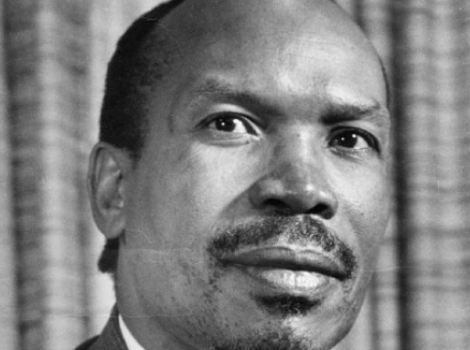
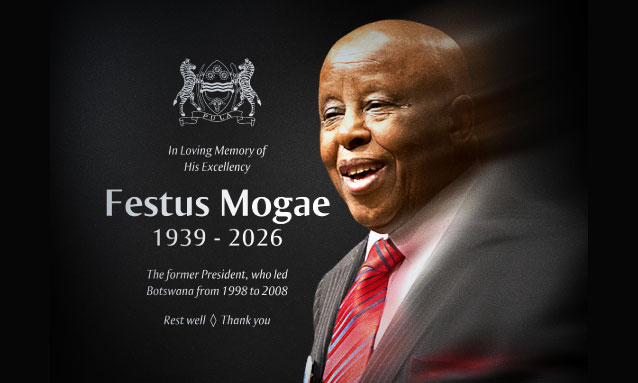
Botswana’s former head of state Dr Festus Mogae has died at the age of 86, President Duma Boko announced yesterday.
“Today Botswana mourns a distinguished statesman and patriot whose life was devoted to the service of his country,” Boko announced, adding that Mogae died early on Friday.
The former president, who led Botswana from 1998 to 2008, had been in ill health for some time. In a statement last month, the government said he was receiving medical care at a hospital in the capital, Gaborone, without disclosing the nature of his illness.
Dr Mogae, the country’s third president, is widely credited with strengthening Botswana’s economic management and governance systems during a period of rapid growth driven by diamond revenues. In his address to the nation on Friday, Boko hailed Mogae as a leader who “stood firmly for discipline, good governance, economic prudence and the advancement of our nation”.
“Under his leadership, Botswana earned its international respect for principled governance,” added Boko.
Boko declared three days of national mourning, during which flags will fly at half-mast in honour of the late leader. Before assuming the presidency, Mogae held senior positions in government including finance minister and later vice-president.
He is also widely credited with steering Botswana’s response to the HIV/Aids epidemic. At the time, his country had one of the world’s worst infection rates, but an ambitious antiretroviral treatment programme significantly reduced infection and mortality rates.
Even after leaving office, he remained an advocate for HIV/Aids treatment in the region, pushing for free antiretroviral therapy and measures to prevent mother-to-child transmission.
He was subsequently involved in various international advisory and peace mediation roles across the continent.
In 2008, Mogae won the the Ibrahim Prize for Achievement in African Leadership – one of the most prestigious honours for African governance – recognising his democratic leadership and peaceful transfer of power. As well as the $5m (£3.6m) prize, Dr Mogae was awarded $200,000 a year for the rest of his life.
Mogae was succeeded as president by Ian Khama. Botswana is one of Africa’s most politically stable countries – it has never had a coup and has had regular multi-party elections since independence in 1966.
A distinguished statesman and patriot – a modest man
In his post-presidency life, when Dr Mogae was asked what he missed most about the presidency, or if he still wishes to go back to the role, he said he had had enough….. probably the only thing he missed was a ride in the presidential helicopter.
Modest indeed, intelligent, visionary, clear and unambiguous, determined, a statesman, a pan- africanist by expression and action; he saw something he termed afro-pessimism where there was insistence on seeing Africa negatively, but believed Africa was improving. In truth, more African countries have become democratic, with an average economic growth of 4.7% in the 2000s.
Leader – born or made?
A bit of both. Dr Mogae was the child of a headman (sub-tribal chief), a member of royalty and therefore born into leadership. Yet, he held leadership roles for a significant part of his life while growing up, learning the art of leadership. He was nominated student leader when he became the Secretary General of Botswana Overseas Students Union while studying in the UK. During his service in government, he worked for some time and had to make decisions quite early in his career. That he worked in government automatically made him a leader because at the time, there were few people in formal employment nationally, and his activities and decisions placed him in a position of authority.
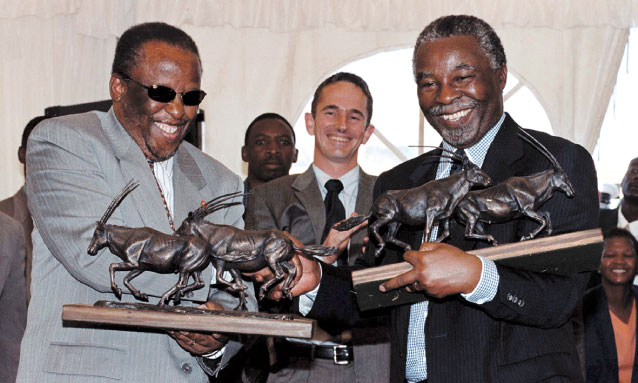
Dr Mogae also had to learn the ropes of leadership by watching those in leadership positions. Both his predecessors – Sir Seretse Khama and Sir Quett Masire – were his role models. The more interesting case is his school principal for a role model, who Mogae saw as a self-made man, a value that bears qualities of resilience and being visionary. He regarded all of his role models to be traditional but educated, liberal and open minded. Overall, watching his role models was a preparation for the role – the making of a president.
Education
Dr Mogae explained that he started school when he was 11 years old in the 1950’s because his parents could not afford to send him to school, and they didn’t appreciate the importance of education as they themselves were not literate. After completing secondary education at Moeng College, he went to England for further studies, where he did his A’Levels at the Northwestern Polytechnic in London. Dr Mogae then went on to study for his BA in Economics at the University College, Oxford, and later acquired a Masters in Development Economics from the University of Sussex.
Public service
In 1968, Dr Mogae joined the Development Planning Ministry (later known as Ministry of Finance and Development Planning) and became instrumental in the rise of Botswana’s economy. He was recruited by the International Monetary Fund in Washington DC in 1976, as an Executive and Executive Director for the Anglophone Africa.
Thereafter, he returned home to serve as the Governor of the Bank of Botswana from 1980-1981, before taking on the role of Permanent Secretary to President Masire in 1982.
Politics and presidency
Dr Mogae left public service to join politics in 1989 under the ruling party Botswana Democratic Party (BDP). Before taking office, President Mogae held several roles in the Government of Botswana, including Permanent Secretary, Ministry of Finance and Development Planning from 1975-1976. He served as Governor of the Bank of Botswana from 1980-1981.
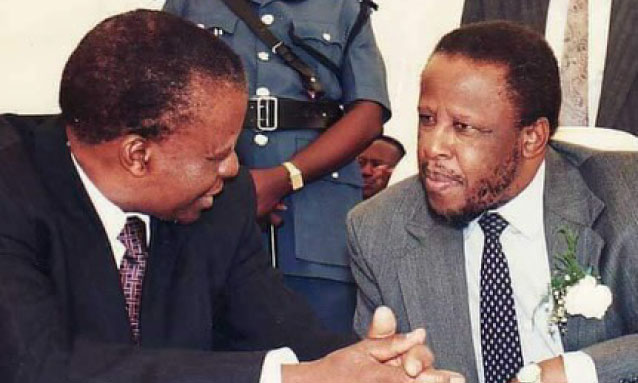
In April 1998, Dr Mogae became the 3rd President of the Republic of Botswana when he succeeded President Masire. Dr Mogae’s party, the Botswana Democratic Party (BDP), retained power in the October 1999 general election.
Dr Mogae was sworn in for a five-year term on 20 October 1999 at the National Stadium in Gaborone, where he vowed to focus on the fight against poverty and unemployment. However, these determined and noble intentions played second fiddle to HIV/AIDS when the epidemic emerged and became the major focus of his agenda for the entire period of his presidency.
Dr Mogae continued the policies of his predecessor, of the national vision 2016, the fight against HIV/AIDS, poverty and unemployment, and successfully steered the nation and economy through difficult times.
Dr Mogae’s main challenge became his making and legacy – the fight against HIV/AIDS in Botswana. He invited international assistance in the fight against HIV/AIDS and in a June 2001 speech before the UN General Assembly, he described the epidemic as a national crisis that threatened the very survival of his people.
Dr Mogae promised to continue tackling poverty and unemployment as he set up the Mogae Scholarship Fund, as well as the spread of HIV-AIDS, which he pledged to eliminate from Botswana by 2016.
Dr Mogae stepped down as President on 1 April 2008 and was succeeded by Vice-President Ian Khama.
Post-presidency
President Mogae is recognised globally as a leading personality in the fight against HIV/AIDS. After leaving office, President Mogae founded and chaired the Champions for an HIV-Free Generation from 2008-2020.
Between 2008 and 2009 he served as one of the UN Secretary-General’s Special Envoys on Climate Change. In 2018, Mogae served as one of the key Members of the WHO High-Level Commission on Non-Communicable Diseases (NCDs).
Among other high-level international roles, President Mogae was appointed Chairperson of the Joint Monitoring and Evaluation Commission (JMEC) on the peace process for the Republic of South Sudan from 2015-2018; served as the Chairperson of the Coalition for Dialogue on Africa (CoDA); was Chancellor of Botswana International University of Science & Technology (BIUST) from 2012-2023; Chancellor of AMREF International University in Kenya from 2019-2024; and also served as a board member of the Mastercard Foundation for 11 years, from 2010-2021.
In 2002, the Africa-America Institute awarded President Mogae its National Leadership Award, presented only once before to Nelson Mandela. In 2008, he was awarded the Grand Cross of the Légion d’Honneur by French President Nicolas Sarkozy. President Mogae also holds honorary doctorates and fellowships from several institutions, including the University of Botswana and University of Oxford.
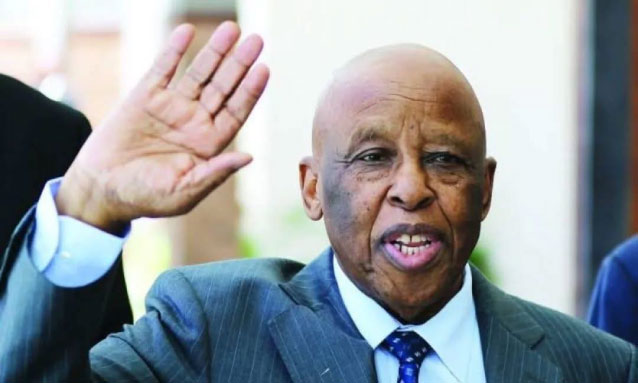
Key awards and distinctions
- Ibrahim Prize (2008): Recognised for strengthening democracy and tackling HIV/AIDS.
- Légion d’honneur (2008): Awarded the Grand Cross by France.
- WHO Public Health Champion (2023): Recognised for contributions to public health.
- Additional Honours: Included the 2002 AAI National Leadership Award, 1989 Presidential Order of Honour, and 2004 Knight Commander of the Order of Lesotho.
- Academic Recognition: Received honorary degrees from the University of Botswana (1998) and Oxford (2003).
- AIDS Leadership: Honored by Harvard (2001) and Medunsa Trust (2000) for HIV/AIDS advocacy
Source: https://shorturl.at/W5zcc & https://shorturl.at/41jG5 & https://shorturl.at/HU72F