24 April 2026
South Africa is definitely not alone in its battle against one or more of the SAT (Southern African Territories) strains of foot-and-mouth disease (FMD). Countries well beyond Africa are now reporting their first-ever infections with the likes of the SAT1 strain. Meanwhile, unknown nefarious forces have threatened to spread FMD even further across Botswana.
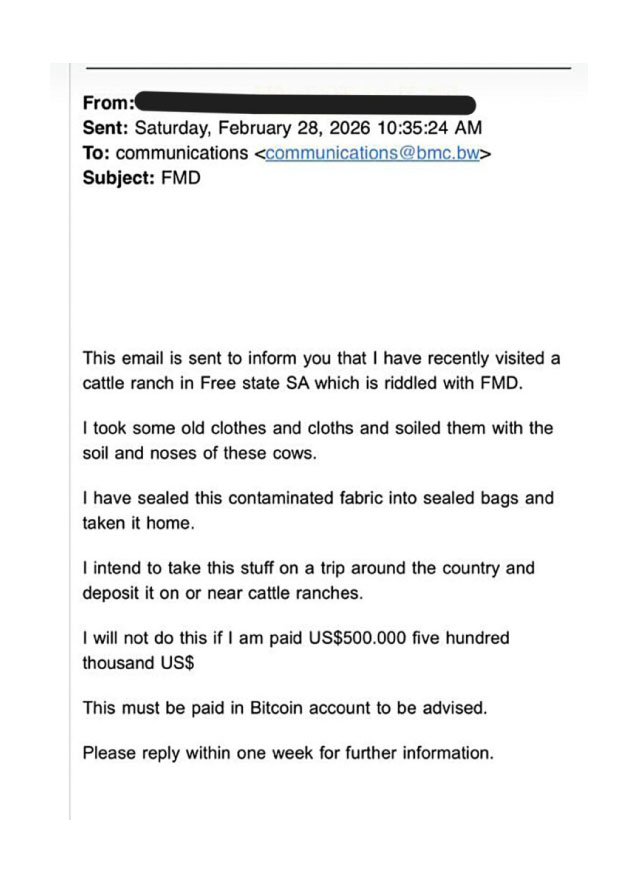
Botswanan authorities are investigating threats reportedly emailed to the state-owned Botswana Meat Commission (BMC). According to the state-owned Botswana Press Agency (BOPA), the BMC first received such an email in late February. The sender demanded US$500 000 (about R8.2 million) to be paid in bitcoin.
The sender threatened to deliberately spread FMD across cattle ranches in Botswana if the amount was not paid. BOPA further reports that the BMC received a second email in March 2026, with the sender demanding to know why the amount had not been paid and the threat ignored.
Dr Edwin Dikoloti, Botswana’s acting minister of Lands and Agriculture, said:
“Relevant authorities are investigating the matter intensely to determine whether the emails are linked to the [current] FMD outbreak.”
Botswana has confirmed FMD outbreaks in at least 10 different locations since early February. While most have been among communal cattle, outbreaks have also been confirmed at the state-owned Ramatlabama National Artificial Insemination Laboratory and at the SW Bruwer and Sons feedlot in disease control zone 11.
Dikoloti’s ministry reports he told a recent meeting with livestock farmers in zone 11 that the World Organisation for Animal Health (WOAH) has given Botswana 24 months to eliminate FMD in its zones that were previously recognised internationally as FMD-free without vaccination, or as a green zones.
“If the country fails to do this within two years, these zones will be declared as red (infected) zones.”
The European Union (EU) is the largest importer of Botswana’s meat, especially beef. It has suspended these beef imports until Botswana’s previously green zones have regained their FMD-free status and the EU’s requirements for such imports are again satisfied.
BMC’s positive turnaround in jeopardy again
For its financial year ended 31 December 2025, the BMC reported its first profits since 2016. African Farming also reported in March this year that the BMC, which has long been the only company allowed to export meat from Botswana, is in the process of gradually upgrading its three abattoirs, especially the largest situated in that country’s Lobatse district.
BOPA reports that Dikoloti recently announced the temporary closure of the BMC’s operations in response to the ongoing spread of FMD and associated livestock movement controls in that country.
“The closure has negatively impacted the gains that the Botswana Meat Commission had recently begun to realise.
BMC has meat worth at least P2 million (approximately R2.4 million) in its storage, some of which was already paid for by international customers, and we will not be able to deliver it due to the FMD outbreak.”
Botswana’s Emergency Operations Centre, comprising multiple state departments, including the country’s defence force, as well as private sector stakeholders, continues to clamp down on any unauthorised movements of people, vehicles and animals – or the products thereof – that might introduce or spread FMD further.
Meanwhile, the WOAH recently warned the SAT1 strain of FMD has spread beyond its historical African range. This strain has been confirmed in outbreaks in countries previously free of SAT1, including those in Southern Africa, Asia, Europe and the Middle East. The dynamic nature of this epidemiological situation underscores the need for sustained global vigilance and adapted actions.
Zambia is one of the Southern African countries that also recently experienced a new outbreak of the SAT1 strain of FMD.
25 Countries with FMD so far this year
In light of the evolving epidemiological situation associated with FMD virus strain SAT1, WOAH recommends that its members:
- Update national and regional FMD risk assessments, taking into account the changing distribution of SAT1, animal movements and trade pathways, and to adopt proportionate science-based risk mitigation measures in line with the Terrestrial Code;
- Enhance clinical surveillance and diagnostic capacity, particularly in areas at higher risk of virus introduction, to ensure early detection and rapid response;
- Conduct regular virus characterisation and genotyping in affected areas to monitor viral evolution, to detect the incursion of strain SAT1 early on and to support evidence-based decision-making;
- Review and, where appropriate, adjust vaccine strategies and antigen composition to ensure continued effectiveness against circulating strains and to control vaccine quality;
- Strengthen preparedness and contingency planning, including collaboration with other national authorities involved in emergency response and regular simulation exercises, to ensure effective implementation of measures; and
- Coordinate with neighbouring members and regional networks to support a rapid and proportionate response.
The World Animal Health Information System (WAHIS) reports that so far in 2026, FMD has been confirmed in 25 countries, namely Algeria, Botswana, Burkina Faso, Cambodia, China, Comoros, Côte d’Ivoire, Cyprus, Eritrea, Eswatini, Greece, Guinea, Indonesia, Israel, North Korea, South Korea, Lebanon, Lesotho, Malaysia, Mongolia, Mozambique, Palestine, South Africa, Zambia and Zimbabwe.
Source: https://shorturl.at/R2hRT