20 October 2026
TSX-V-listed Tsodilo Resources has progressed strategic collaborative research alliances supporting its critical minerals and rare earth element (REE) exploration at its 100%-owned Gcwihaba Metals project, in north-west Botswana.
The alliance pairs the company’s exploration database with specialist institutions, the Botswana Institute for Technology Research and Innovation (BITRI), University of Cape Town (UCT) and Battelle Memorial Institute.
The BITRI and UCT programmes are geological studies of a small number of drill core samples, selected to understand the mineralogy, rock chemistry and texture of the C27 skarn and how REEs are hosted. Following the collaborative research initiative announced in May, in which Tsodilo indicated it would engage BITRI scientists with respect to sample preparation and analysis, BITRI’s Centre for Material Science has completed a preliminary geochemical and mineralogical characterisation of four selected drill-core samples from the C27 skarn at the Gcwihaba project.
All analyses were performed at its Gaborone laboratories using X-ray diffraction (XRD), X-ray fluorescence (XRF), inductively coupled plasma mass spectrometry, and scanning electron microscopy with energy-dispersive spectroscopy (SEM-EDX).
Of the four samples analysed, TREE-C27-6-119 returned the highest result: 1 794 parts per million (ppm), including 403 ppm critical REEs. Results across the four samples ranged from 85 to 1 794 ppm, and all four samples show strong light-REE-enriched patterns, Tsodilo points out.
SEM-EDX imaging of sample TREE-C27-6-119 showed iron-associated cerium/lanthanum/neodymium-rich inclusions within micro-fractured, weathered pyroxene, while XRD identified skarn mineralogies ranging from near-pure magnetite to diopside-rich calc-silicate across the four samples. Base and precious metals are also present at trace levels.
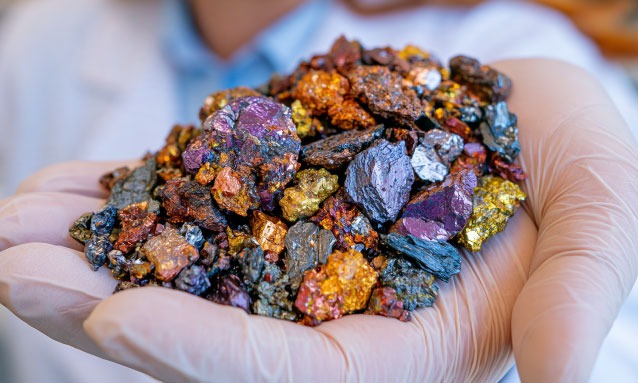
Meanwhile, a UCT research team has completed a preliminary mineralogical study of C27 drill core using two complementary techniques: micro-X-ray fluorescence (micro-XRF) element mapping and QEMSCAN automated mineral mapping. Both techniques give consistent results on the same sections and indicate that cerium-rich allanite (Ce-allanite), a rare-earth-bearing mineral of the epidote family, is the principal REE host.
From analysis works, coarse allanite can be seen in drill core. These findings will help guide core logging and sampling in the company’s upcoming planned drill programme. Follow-up electron-microprobe, LA-ICP-MS and oxygen-isotope work will measure the REE content of each allanite group, a key input to future metallurgical testwork and most importantly, help identify the source of the mineralising fluids.
C27’s Ce-allanite-dominant skarn mineralogy is comparable to the Bastnäs-type REE skarns of Sweden, the allanite-bearing skarn zone of the operating Sin Quyen copper mine in Vietnam, and the allanite-bearing gold/copper skarn systems of Yunnan, China (Beiya and Machangqing), where hydrothermal allanite carries the light rare earths, Tsodilo points out.
Also, Battelle has completed a first-stage AI model trained on the company’s Gcwihaba exploration database, integrating drillhole geochemistry with regional gravity, magnetic and electromagnetic survey data.
Designed to work with the incomplete, multi-survey coverage typical of historical exploration datasets, the model is intended to support the identification of REE-anomalous drillholes; in Battelle’s internal testing it performed at a level comparable to a standard benchmark approach, with performance expected to improve as additional data are incorporated. Tsodilo intends to incorporate the model’s output into the ranking of exploration target areas and identify additional areas of interest for follow-up exploration and future targeted drilling campaigns.
“We are very encouraged by how these three collaborations now work together across the Gcwihaba exploration value chain, from the minerals in the rocks to the drill targets.
“BITRI’s geological study has characterised the C27 skarn rock types and their polymetallic signature; UCT’s mineralogical study shows that cerium-rich allanite carries the rare earths in our mineralised core, and that coarse allanite can be recognised in core during logging, giving our geologists a quick visual guide to REE-rich zones; and, Battelle has delivered the first-stage AI model we announced in March. Each layer adds to and sharpens the next,” Tsodilo CEO and chairperson James M Bruchs explains.
“Equally important, this progress is being built with Botswana’s own scientific institutions, creating lasting in-country capability alongside international expertise. With follow-on work under way on all three fronts, we look forward to using these insights to guide planned follow-up drilling, and to sharing further results as these collaborations advance,” he adds.
By Tasneem Bulbulia
Source: https://shorturl.at/F4KN2