24 June 2026
As governments across Africa face growing fiscal pressures and increasing demands for transparency, the role of parliament in overseeing public finances has never been more important.
In Botswana, as a renewed parliamentary mandate have sharpened the focus on accountability and effective governance, parliamentarians and experts from across Africa and Europe gathered in Gaborone from 10–12 June 2026, to explore one critical question: how can parliaments strengthen oversight of public spending and state-owned enterprises to better serve citizens?
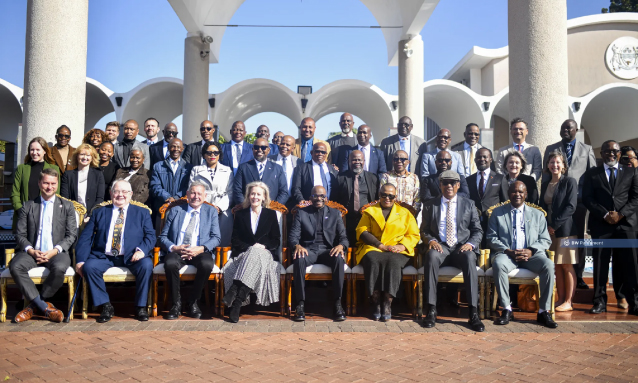
Hosted by the National Assembly of Botswana in partnership with Inter Pares – Parliaments in Partnership, which is funded by the European Union, the workshop on Parliament’s Budgetary Engagement and Oversight of Public Enterprises brought together participants from Botswana, Denmark, Ireland, Malawi, Slovakia, South Africa, and Zambia to exchange experiences and identify practical approaches to strengthening democratic accountability.
Through peer learning, comparative discussion, and practical exercises, participants examined how parliaments can enhance accountability, transparency, and effective stewardship of public resources.
The event responded directly to priorities identified by the National Assembly of Botswana following the 2024 elections, as Parliament seeks to strengthen its oversight role and reinforce public confidence in democratic institutions.
A renewed focus on parliamentary oversight Opening the workshop, Dr Gabriel G. G. Malebang, Clerk of the National Assembly of Botswana, described the event as a significant step in the institution’s ongoing development.
“This workshop on Parliament’s Budgetary Engagement and Oversight of Public Enterprises marks a major milestone in the growth and resuscitation of our parliamentary committees,” Malebang said.
“It is only recently that the new leadership took the decision to be intentional about reviving and strengthening Parliament’s oversight function.
Dr Malebang noted that the workshop forms part of a broader effort to transform the National Assembly into a high-performing institution capable of delivering effective oversight, accountability, and service to the people of Botswana. He highlighted the value of bringing together parliamentarians, government officials and experts from different jurisdictions to exchange practical experiences and approaches to overseeing public expenditure.
Representing the European Union, Ambassador Petra Pereyra underscored the broader democratic significance of parliamentary scrutiny and accountability. Oversight is not merely a technical function; it is the foundation of democratic trust and the legitimacy of the decisions we make, especially when those decisions are shaped through consultative and inclusive processes, she said. Her remarks reinforced a key theme of the workshop: that effective oversight strengthens not only public financial management, but also citizens’ confidence in democratic institutions.
Parliament-led development through partnership
The workshop builds on more than two years of collaboration between the National Assembly of Botswana and Inter Pares. During this period, the partnership has supported initiatives on legislative scrutiny, public participation, climate and conservation governance, gender-sensitive parliaments, and institutional strengthening.
Speaking on behalf of International IDEA and Inter Pares, Jonathan Murphy, Head of Programme, highlighted the importance of parliament-led development and peer-to-peer exchange.
The most powerful oversight is the oversight that happens before the money is committed, Murphy noted, emphasising the importance of parliamentary scrutiny early in the policy and budget process. Murphy noted that the workshop reflects a core principle of Inter Pares: parliamentary development is most effective when it is driven by the needs and ambitions of parliament itself. Bringing together participants from across Africa and Europe, the workshop created an opportunity for parliaments facing similar oversight challenges to exchange experiences and learn from one another.
Murphy also presented Inter Pares’ recently launched Handbook on Parliamentary Oversight of Large-Scale Infrastructure Projects, which provides practical guidance for parliamentarians overseeing complex public investments. Drawing on experiences from across Africa and beyond, the handbook highlights how timely scrutiny, transparency, and accountability can help ensure that major infrastructure projects deliver lasting public value.
Oversight beyond budget approval
The workshop’s keynote address was delivered by Rt. Hon. Dithapelo Keorapetse, Speaker of the National Assembly of Botswana, who underscored Parliament’s constitutional responsibility to safeguard the public interest through effective financial scrutiny and accountability.
“Parliament exists to represent the people and to hold the Executive accountable on their behalf,” he said.
“It is an institution entrusted with safeguarding the public interest.”
The Speaker stressed oversight extends far beyond the approval of government budgets. In a context of increasing fiscal pressures and declining diamond revenues, he emphasised the importance of Parliament remaining engaged throughout the entire budget cycle to ensure public resources are used effectively and in line with national priorities.
Strengthening accountability for state-owned enterprises
A central focus of the workshop was the oversight of state-owned enterprises. Across many countries, SOEs play a critical role in delivering public services and supporting economic development. At the same time, they can present significant fiscal and operational risks when governance and accountability mechanisms are weak.
Participants explored approaches to strengthening parliamentary oversight of SOEs while respecting their operational independence. Discussions examined the role of committees, supreme audit institutions, access to information, performance monitoring, and mechanisms for following up on audit findings.
The Speaker also emphasised that Parliament’s responsibility is not to manage public enterprises directly, but to ensure accountability in how they are governed. Parliament’s role is not to manage SOEs. Rather, it is to ensure that the Executive exercises its ownership responsibilities transparently, efficiently, and in the best interest of the people of Botswana, said Speaker Dithapelo Keorapetse.
Building stronger institutions for better scrutiny: Learning across borders
Throughout the workshop, participants examined comparative experiences from across Southern Africa and Europe, exploring how parliaments can strengthen budget scrutiny, improve access to financial information, and enhance oversight throughout the budget cycle. Sessions combined expert presentations, peer exchange, and practical exercises designed to strengthen the capacity of Members of Parliament and parliamentary staff to carry out their oversight responsibilities effectively.
The value of peer exchange was echoed by participants from across the region and Europe. Reflecting on the discussions, Darina Luščíková, Member of Parliament of the Slovak Republic, noted that despite different political and institutional contexts, parliaments often face similar oversight challenges.
“Although our countries differ, many of the challenges we face are surprisingly similar. Slovakia has well-established and independent oversight institutions, which are an important strength of our system.
At the same time, the discussions raised an important question: how can the findings and expertise of these institutions be translated more effectively into better management of public finances and state-owned enterprises? This exchange of ideas was one of the most valuable aspects of the workshop for me,” Luščíková said.
This sentiment was echoed by Hon. Sosten Gwengwe, Chairperson of the Parliamentary Budget and Finance Committee of Malawi, who highlighted the practical value of sharing experiences across parliamentary systems.
“What stood out most was how sharing lessons across borders helps us strengthen accountability without reinventing solutions,” he said.
“The workshop’s exploration of tools for monitoring budget implementation, including in-year expenditure reports, mid-year reviews, supplementary budgets, and site visits, provided concrete insights into what conditions make each tool effective in practice.”
Dr Nelia Orlandi, Deputy Director of the Parliamentary Budget Office of South Africa, highlighted the role of specialised expertise in supporting effective parliamentary oversight.
“The workshop emphasised the importance of independent fiscal analysis to strengthen parliamentary budget scrutiny, transparency, and evidence-based decision-making,” she said.
“The value of peer learning extends beyond theoretical knowledge, as it enables the sharing of practical experiences, lessons learned, and real-world insights that deepen understanding and support meaningful institutional development.”
This perspective was also shared by Seán Ó Fearghaíl, former Speaker of Dail Eireann, Ireland, who reflected on the value of exchanging experiences across parliamentary systems.
“It was particularly rewarding to engage with parliamentarians from across the region on issues that are central to effective democratic governance,” he said.
“While every parliament operates in its own context, the challenges of ensuring accountability, transparency, and public trust are remarkably similar. Sharing experiences helps us learn from one another and strengthen our institutions in practical ways.”
The discussions on Parliamentary Budget Offices and independent fiscal institutions highlighted how specialised expertise and independent analysis can strengthen legislative scrutiny and accountability. Participants also explored the importance of stronger collaboration between Parliament and supreme audit institutions and how it can help ensure that audit findings lead to tangible improvements in transparency, accountability and good governance.
Looking ahead
Looking ahead, participants identified opportunities to strengthen parliamentary autonomy, deepen parliamentary engagement throughout the budget cycle, including activating the role of committee in budget scrutiny, enhance collaboration with oversight institutions, improve access to information relating to state-owned enterprises and frame the entire oversight work around the potential benefit to citizens.
In his closing reflections, Dr Malebang noted that strengthening parliamentary oversight is ultimately an institutional project.
“It is about building systems that outlast individual parliamentary terms.”
He emphasised the importance of strong committees, evidence-based decision-making, access to expertise, and a parliamentary culture grounded in accountability and public service. The true success of the workshop, he observed, will be measured by how its lessons inform future committee inquiries, budget debates, audit follow-up, and oversight of public institutions.
By fostering peer learning and sharing experiences across parliamentary systems, the workshop reinforced the National Assembly of Botswana’s commitment to strengthening democratic accountability and effective governance.
It also demonstrated the value of parliamentary partnerships in supporting long-term institutional development.
Inter Pares will continue its partnership with the National Assembly through additional activities later this year, including an exchange focused on advancing women’s political participation. Drawing on the discussions and comparative experiences shared during this workshop, Inter Pares will also develop a Parliamentary Brief on the Parliamentary Oversight of State-Owned Enterprises, capturing key lessons, practical approaches, and emerging good practices to support parliamentary oversight across the region.
Source: https://shorturl.at/711hP