7 April 2026
As the afternoon sun glints off a half-open bonnet, Harry Gulubane is crouched beside the car in his backyard. Wrench in hand and with the smell of oil and dust mingling on the wind in Francistown, Botswana, Gulubane, an English teacher, is quietly doing one of the things he loves most —fixing cars. He finds huge satisfaction in bringing broken things back to life.
But two years ago, it was his own life that needed repair. Family vacations are a tradition for Gulubane, his wife and two daughters. In December 2023, they set out once again on a trip that brought them first to Gaborone, the capital of Botswana, to visit extended family, and then on to Windhoek in Namibia, before heading home to Francistown in eastern Botswana. Tragically, the family was involved in a road accident that claimed the life of one daughter and left Harry with injuries so severe he could barely stand. His wife and the other daughter survived with minor injuries.
“I broke an elbow, dislocated my left arm and had a spinal injury,” Harry recalls, his voice filled with pain and gratitude for how far he has come since.
For weeks, his world contained little more than pain and uncertainty. He was unable to attend his daughter’s funeral nor perform the simplest tasks on his own.
“Since the accident, up until surgery, I was almost immobile. But Thabo Dr Rowland, a professional neurosurgeon at Francistown Academic Hospital (FAH) was outsourced to do the procedure, and orthopaedic and trauma surgeon Dr David Mhembelo attended to me for the elbow injury,” notes Harry.
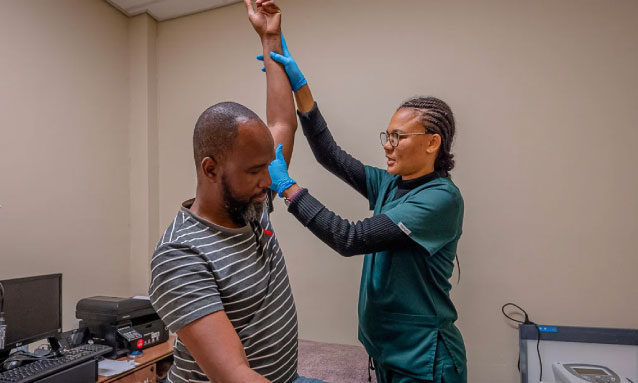
Step by step, stretch by stretch, in physiotherapy at FAH, Harry’s body began to remember what it had lost.
“I’ve been fixing cars since I was young. You talk cars, I’m your man.”
Francistown Academic Hospital,which has become a centre of medical excellence in the region, sits on the eastern edge of the city, a few kilometres from the bustle of the town centre.
Inside, FAH hums with the purpose of a staff whose compassion is matched by their skill and training. The hospital offers 18 specialities and performs community outreach.
“So far, we have covered 30 villages and towns, through our outreach programme,” said Dr Sant Parkash Singh, FAH’s founder.
“The community knows they can come to FAH for all types of treatment because we have multiple specialities.”
A Bigger picture of care
Behind the hospital’s life-saving work lies a story of investment and vision. Francistown Academic Hospital has recently undergone a transformation, thanks to the Botswana Development Corporation (BDC), and with support from the African Development Bank, which provided over $1 million as part of an $80 million credit line for 14 development projects.
Kudzane Pickup, BDC’s Chief Investment Officer notes,
“The funds went beyond expanding wards and purchasing new equipment —they also meant jobs, not just for the medical professionals, but for local support staff, construction workers and suppliers.”
In total, 185 jobs have been created as of July 2025. In fact, Francistown Academic Hospital has become more than a hospital – it now anchors the city and the wider community, as the experience of another patient, 52-year-old Mathodi Modisapudi, can attest.
Modisapudi works as a nominated board member in Masunga at the Tati Land Board, 120 kilometres from Tati Siding village where she resides with her family. On 20 November 2024, while on a field assignment, Modisapudi felt an unexpected warm trickle of liquid down her legs. She asked the staff driver to take her to a nearby hospital. Little did she know that it was the start of a series of tiring hospital visits.
“I was given a five-day sick leave after the hospital visit in Masunga. A few days later, my period started and never stopped,” Modisapudi said.
She went for a pap smear in February 2025. The results came back negative for cancer, but the bleeding did not stop, and soon she felt too weak to continue working. On April 10 of that year, Modisapudi collapsed and was rushed to Nyangabwe Hospital where she stayed for eight days. It emerged she had one of the largest fibroids, weighing 1.8 kilograms, ever recorded. Expensive surgery was the only option.
During a consultation in Gaborone, she was referred to Dr. Elie Ndala, a gynaecologist and obstetrician at Francistown Academic Hospital. With the support of friends and family, Modisapudi managed to raise 38,000 pula ($2,850) to pay for her surgery. But it was not enough.
“The surgery would cost me 54,000 pula ($4,045), she recalls “I was afraid I could not afford it.”
But the hospital did not turn her away.
“They not only made a payment plan for me to comfortably clear the balance once I got better but also gave me a discount.
That meant everything to me. I don’t know how to explain the love and care I received from FAH staff. I have recovered, I am happy, and I can work now.”
The stories of Gulubane and Modisapudi speak not only to personal resilience but also to the difference accessible, well-equipped health systems can make when they are designed to serve patients first. Behind each recovery lies an ecosystem of trained professionals, functioning facilities, and sustained investment.
The experiences demonstrate the tangible impact of the African Development Bank’s funding to support quality of life in Africa.
Source: https://shorturl.at/tweh3