15 September 2026
- KPI Green Energy’s audited FY26 consolidated accounts show ₹424 crore ($47 million) of net cash from operations against ₹2,682 crore ($298 million) spent on fixed assets and capital work in progress, while the company’s expansion was financed largely through new borrowing
- The chief financial officer told analysts in August that annual interest could reach about ₹450 crore ($50 million) on roughly ₹5,000 crore of debt as the company’s asset base expands, slightly above the operating cash generated in FY26
- Management has estimated the 500 MW first phase in Botswana at ₹1,500–1,700 crore ($167–189 million) and said equity was available and lenders had shown interest
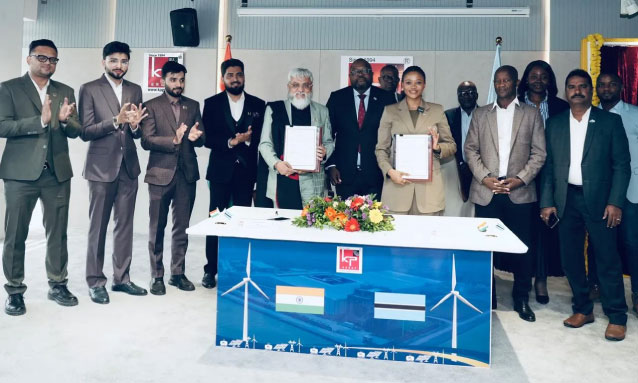
KP Group has announced plans to invest about $4 billion in Botswana in nearly 5 GW of renewable generation, energy storage and transmission infrastructure, one of the largest energy investment commitments announced in the country. The programme is expected to begin with a 500 MW project being developed through KPI Green Energy, the Indian group’s listed renewable power company.
The scale of the announcement raises a financing question. KPI Green is expanding rapidly at home, but its latest audited accounts show that capital spending is already running far ahead of the cash generated by its operations. KPI Green Energy generated ₹424 crore ($47 million) of net cash from operating activities in the year to March 2026. Over the same 12 months, it paid ₹2,682 crore ($298 million) for fixed assets and capital work in progress, plus another ₹844 crore ($94 million) in advances to capital creditors.
The expansion was financed largely through borrowing. KPI Green raised a net ₹2,804 crore ($312 million) in long-term debt and ₹602 crore ($67 million) in short-term borrowings during the year, alongside other financing flows. Cash and equivalents ended the year at ₹116 crore ($13 million), slightly below where they started.
All conversions use ₹90 to the dollar, the rate implicit in KP Group’s announcement valuing its planned Botswana investment at ₹36,000 crore, or about $4 billion. Operating cash covered roughly one rupee in six of spending on fixed assets and capital work in progress. Part of the gap reflects the working-capital demands of a company rapidly expanding its asset base. Inventories more than tripled to ₹1,449 crore ($161 million). Part also reflects the normal model of an independent power producer, which builds generating assets before they begin producing revenue.
Neither changes the scale of the financing requirement. Total borrowings rose from about ₹1,125 crore ($125 million) to ₹4,532 crore ($504 million) in one year. Audited total equity stood at ₹3,273 crore ($364 million). Finance costs increased from ₹79 crore to ₹182 crore ($20 million), while net profit reached ₹509 crore ($57 million) on revenue of ₹2,696 crore ($300 million).
Against that balance sheet, the approximately $4 billion Botswana programme announced by KP Group is equivalent to about 11 times KPI Green Energy’s FY26 equity. The comparison is not exact: the Botswana memorandum was signed at group level and includes renewable generation, storage and transmission infrastructure, while KPI Green Energy is one company within KP Group.
The analyst who did the sum on the call
One of the more revealing exchanges in the company’s August 12 earnings call was not directly about Botswana. Asked about interest costs, Chief Financial Officer Salim Yahoo said the borrowing rate was around 8.5% and that annual interest could reach roughly ₹450 crore on about ₹5,000 crore of debt as the company’s expansion progresses. Asked separately about the investment behind that debt, he said total investment could rise above ₹5,000–6,000 crore as the asset base expands through FY2027 and FY2028.
Garvit Goyal of Serene Alpha then tested those assumptions against management’s earnings guidance. Using an initially stated depreciation assumption of about 15%, he calculated that ₹5,000–6,000 crore of assets could generate ₹750–900 crore of annual depreciation, against roughly ₹450 crore of interest and around ₹850 crore of IPP EBITDA guidance.
“So where is the profit then?” he asked.
Management responded that the earnings guidance was conservative and covered only part of the capacity under construction. Yahoo also revisited the depreciation assumption during the exchange, saying the effective rate for long-lived power assets would be closer to 5% rather than 15%, materially changing the calculation.
The exchange nevertheless illustrates the financing constraint behind KPI Green’s expansion. For scale, the projected ₹450 crore ($50 million) annual interest bill is slightly above the ₹424 crore of operating cash the company generated in FY26, although the debt would support a larger operating asset base than the one that produced that cash flow.
On Botswana itself, management has disclosed more than the initial headline suggests. KP Group’s memorandum covers nearly 5 GW of renewable capacity and associated infrastructure, with total investment estimated at about $4 billion. KPI Green has said the first phase would comprise 500 MW and would operate as an independent power producer.
During a January earnings call, Yahoo estimated the first phase would require roughly ₹1,500–1,700 crore ($167–189 million). He said the equity component was already available and that several lenders had shown interest in financing the project. Management also discussed the possibility of eventually using structures such as an infrastructure investment trust or bringing in other investors.
The latest disclosures show that development work remains underway. KPI Green’s investor presentation said 500 hectares of land had been identified and that the acquisition process was underway.
During the August earnings call, however, Yahoo said the land had already been acquired. A footnote to the published transcript corrected his spoken reference to “500 acres” to 500 hectares.
The company has also said negotiations over power purchase agreements were at a very advanced stage, but the available disclosures reviewed for this article do not announce a signed PPA. Management said the Botswana project would generate no revenue during the current financial year.
There is one more number worth setting against the nearly 5 GW planned in Botswana. KP Group has repeatedly stated a goal of exceeding 10 GW of capacity by 2030, from a portfolio already above 8.5 GW and about 2.5 GW installed.
The proposed Botswana capacity alone is equivalent to roughly half that 10 GW threshold.
The company has not made clear how the full Botswana programme fits into that group target. The next set of accounts should provide another test of how quickly the project is moving from memorandum to financial commitment. The line to watch will not only be revenue, but whether Botswana begins appearing among the company’s disclosed capital commitments, financing arrangements or project liabilities.
Source: https://shorturl.at/EocBO