9 April 2026
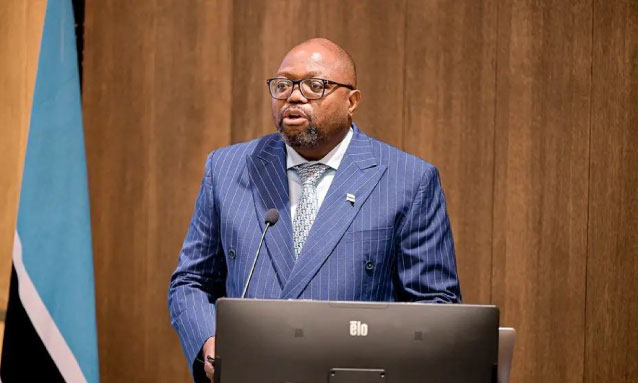
In an interview with The Africa Report, Foreign Minister Phenyo Butale sets out why Botswana is courting investors, repairing regional ties and widening its global partnerships.
Diversifying Botswana’s diamond-dependent economy is now an “existential” task, Foreign Minister Phenyo Butale says, as President Duma Boko’s new government tries to turn the country’s political stability into a magnet for investment, trade and private-sector growth.
For Butale, that means recasting foreign policy as economic diplomacy. Botswana, he says, must use its reputation for stability and its position in Southern Africa to attract capital, deepen regional trade and build new engines of growth beyond diamonds.
“I have been going around the world, preaching this message that we are the most stable country in the world,” he tells The Africa Report after a parliamentary session, before hurrying to a ruling-party caucus.
The shift comes after a rare political turning point. The transfer of power from the Botswana Democratic Party, which ruled for 58 years, to Boko’s Umbrella for Democratic Change has helped the new government present itself as reformist, business-friendly and outward-looking.
Economic and diplomatic reset with South Africa
“We want to transition from development that is dependent on government spending to that which is private sector-led,” Butale says.
“That requires us to leverage investments from international development partners, from countries with whom we have relations.”
That economic message is being paired with a broader diplomatic reset. Gone, for now, is the rancorous tone that at times marked relations with neighbouring South Africa under the previous administration.
Relations with South Africa, Botswana’s biggest economic partner, are also being recast in more pragmatic terms. The new government has tried to draw a line under the rancour of the Masisi years, including the long-running Motsepe-Radebe saga. Botswana had accused South African mining executive Bridgette Motsepe-Radebe of involvement in a purported plot against the previous administration before later apologising.
Trade has been part of that reset too. Botswana had imposed restrictions on selected fruit and vegetable imports in 2022 to support local farmers, a policy the Masisi government defended as import substitution; but the Boko administration moved in late 2024 to lift some of those curbs, easing friction with South African producers and signalling a more open, integration-minded approach to regional commerce.
With Botswana still heavily dependent on South African goods, the message is clear: political calm with Pretoria is not a nicety, but an economic necessity.
The Boko government has sought to lower the temperature and present Botswana as a more predictable partner for business and diplomacy alike.
Geography is part of the pitch. Landlocked but strategically placed between South Africa, Namibia, Zimbabwe and Zambia, Botswana sees itself as a potential gateway into the wider Southern African Development Community (SADC). For Butale, regional integration is not a slogan but a commercial necessity.
A matter of survival
“It’s an existential issue,” he says of diversification, describing it as a matter of survival. The government wants to encourage agriculture, manufacturing and digitalisation, while using Botswana’s location to plug more effectively into regional supply chains.
That logic is visible in its push to strengthen transport and border infrastructure. In February, Boko and Zambian President Hakainde Hichilema met at their shared frontier to inaugurate the Kazungula Bridge Authority, part of a broader effort to cut lorry congestion and improve logistics on the north-south corridor.
The two presidents said they wanted the crossing to operate around the clock and eventually move towards a seamless border system, reducing delays through technology rather than cumbersome manual checks. The route is a crucial freight artery for Southern Africa.
Zimbabwe, too, figures in Botswana’s regional calculus. Butale says Gaborone wants closer ties with Harare, pointing not only to trade but to neighbourly support during a recent shortage of essential medicines.
We believe that regional integration is key, because the lucrative SADC market is important for us
After Boko declared a state of emergency over the shortage, Botswana received anti-retroviral medicines from Zimbabwe – 20% as a donation and 80% as a loan to be repaid in kind.
“We believe that regional integration is key, because the lucrative SADC market is important for us,” Butale says.
Russian challenges
That pragmatism extends beyond the region. Botswana is trying to balance a foreign policy rooted in stability and non-violence with a search for partners willing to invest in new sectors. Butale says the country is open to collaboration across mining, agriculture, renewable energy and manufacturing as it tries to develop deposits of copper, iron ore, uranium and manganese alongside its traditional diamond base.
His recent remarks about Russia drew criticism in Botswana, after local media reported that he had called for Moscow to pursue mining contracts in the country. Butale pushes back against the idea that Botswana is tilting politically, arguing that the government is simply open to investment and cooperation from a wide range of partners.
“Botswana is at a point where we require and we are open to collaboration in a lot of sectors in the economy,” he says.
“We want investors that are coming to set up manufacturing plants and factories. We want to create jobs for our people.”
That same logic underpins Botswana’s plan to open an embassy in Moscow, a move that has also attracted criticism. Butale says the decision is driven partly by consular needs, noting that Botswana has students in Russia and that Moscow is the only permanent member of the UN Security Council where Gaborone has no diplomatic representation.
The issue has become more sensitive because of reports that three Batswana men were duped into fighting in the war in Ukraine. One has reportedly escaped, while the whereabouts of two others remain unclear. Butale says he raised the matter with Russian foreign minister Sergei Lavrov on the sidelines of the Russia-Africa summit in Cairo in December, and that Botswana has sent an official request for assistance. South Africa, he adds, is also offering support through its embassy in Moscow.
China is another pillar of Butale’s pragmatic diplomacy. He says Botswana will continue engaging with Beijing and remains open to initiatives such as the Belt and Road. The point, again, is less ideology than economic necessity.
Growing an economy long reliant on natural resources will not be easy. But Butale insists that Botswana has little choice but to widen its partnerships, deepen regional trade and use its diplomatic relationships more aggressively in pursuit of growth.
“We are a consumer economy that imports everything,” he says.
“For us to build an agile, diversified economy, we need to leverage the relationship that we have with multiple countries and multiple international development partners.”
Source: https://shorturl.at/JVv3s
You may also be interested in: