24 October 2025
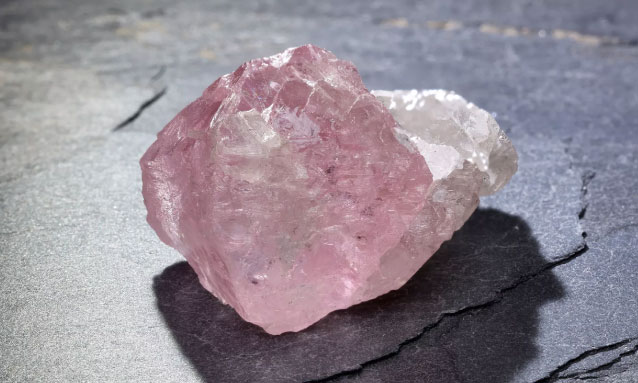
Experts say it’s an extraordinary natural diamond with two distinct colour zones. A rare, two-coloured natural diamond has been unearthed by miners in Botswana.Experts agree that it’s likely it formed in two stages, hence its unique look. It’s also a large one, measuring in at 24.3 by 16 by 14.5 mm and weighing an “astounding” 37.41 carats, or 7.5 grams, according to the California-based non-profit research centre, the Gemological Institute of America (GIA).
In a statement emailed to Live Science, senior manager of diamond identification at GIA, Sally Eaton-Magaña, said that the pink half probably formed first. But there’s a good chance it wasn’t always this rosy.
“The pink section likely was initially colourless and then plastically deformed, perhaps by a mountain-forming event millions of years ago, resulting in its pink colour, with the colourless section forming at a later time.”
Pink diamonds are very rare, and no one is exactly sure how they form. What we do know is that diamonds originate more than 160 km beneath the Earth’s surface, inside a planetary layer called the mantle. The combination of extremely high temperatures and pressure binds carbon atoms together, and this structure can rise quickly to the surface through volcanism. This results in rough diamonds.
The way they acquire colour is if an impurity gets locked inside during the formation process. This, however, is very rare because few elements are small enough to penetrate the mineral structure. Radiation can also give diamonds a tint – usually green – if there are rocks nearby that contain elements like uranium.
Pink diamonds are a result of structural deformity. For it to become this colour, the temperature and pressure conditions have to be just right.
Too much deformation, and the gem can instead turn brown. And there are a lot of brown ones and very few pink ones, so this truly is a rare and special find.
According to GIA, for a diamond to have two distinct colour zones, it must have formed in two phases. First, the pink half assembled and deformed; then, the colourless half sprouted and remained unaffected by temperature and pressure. While this is not the first of its kind, others have been significantly smaller.
This beauty was discovered in the Karowe mine in Botswana. Other spectacular gems have been unearthed there, including the second-largest rough diamond ever recovered – a giant, 2,492-carat (0.5 kg) gem dubbed the “Motswedi” diamond – and the 62-carat (12.4 g) “Boitumelo” pink diamond was found.
Who knows what the next discovery will be at this clearly lucrative mine?
Source: Live Science & https://shorturl.at/bdez7