
17 September 2025
Quick read: Letsile Tebogo was disqualified from the 100 metres final due to a false start. This decision was based on technology that detects early movements. The rules around false starts are being discussed, as officials consider if the current time limit should be adjusted.
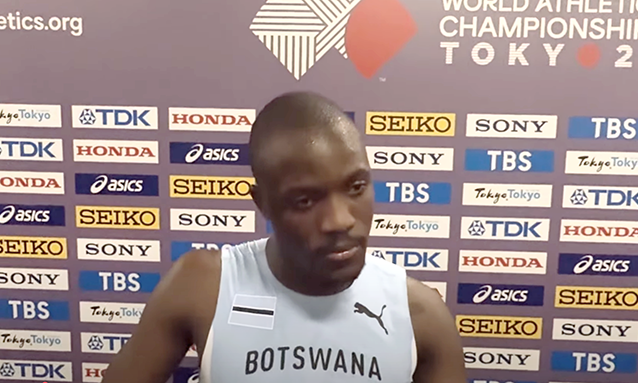
Despite his 100m disqualification in Tokyo, Letsile Tebogo says simply reaching the final was a victory after an injury-plagued season. Olympic 200m champion Letsile Tebogo has opened up about the unfortunate incident before the men’s 100m final at the World Athletics Championships in Tokyo, Japan.
Letsile Tebogo was disqualified for a false start, and he handled the incident maturely, walking off the track, even though deep down he knew his 100m journey ended there. The former world 100m silver medallist was in great shape, winning his heat in 10.07 seconds ahead of the semifinal, where he finished second in 9.94 seconds.
Letsile Tebogo revealed that he did not have the energy to protest at the time, noting that it would also be unfair to his opponents, who were ready to go.
“I just wanted to let go of the race because the guys were ready, and I didn’t want to delay anybody by protesting against the officials.
I had to let them run, congratulate them and see how the race would go,” Letsile Tebogo revealed to reporters after the race.
Letsile Tebogo was not frustrated with the move, and if anything, making the final was a dream come true following the season he had. The world 200m bronze medallist revealed that at the moment, he did not know what had happened and was looking forward to running the final, but things did not go as planned.
“I don’t even know what happened. But just being in that final meant a lot to me. Even though we hoped we could have run that final, looking at how the 100m has just been this whole season, it has just been so rocky,” Letsile Tebogo said in an interview on the Inside Lane.
“It has been a tough mountain to climb, but just being there gave me hope that we are still there in the top names.”
Letsile Tebogo reflects on injury struggles
Letsile Tebogo revealed that this season has not been a walk in the park, as he has struggled with a series of injuries, some of which he made public, but decided to keep silent on others. However, running the 100m has proven to Letsile Tebogo that he is in great shape and ready to run the 200m, noting that even going under 10 seconds was a testimony.
He revealed that for the 200m, he plans to execute just like he did at the Paris Olympic Games last year, where he won the gold medal ahead of Kenny Bednarek and Noah Lyles.
“Man, I’ve had so many injuries that I can’t even count them at the moment. Just that I’d never publish it out there, that I’m going through something, or I have an injury. I just kept it close to the camp and see how best we can mingle around those injuries and come back into the global stage,” Letsile Tebogo added.
“I’m good for the 200m. The 100m showed me that we are fully 100% okay. With the rounds it went with the 9.95 that we ran, it shows that I’m 100% okay. I just need to go into the 200m and execute the same race that I’ve done in Paris.”
Letsile Tebogo will be lining up for the men’s 200m heats on September 17, hoping to go all the way to the final.
Understanding false starts
False starts can happen when an athlete reacts too quickly to the starting gun. In this case, technology plays a role in detecting these early movements. Sensors in the starting blocks measure the pressure an athlete applies, and if the reaction time is less than 0.100 seconds, it triggers an alert for the starter.
Judging the start
When a false start is suspected, officials review data from sensors and video footage to make their decision. They look for any significant movements that might indicate a false start. If the athlete’s movement is deemed not serious enough, they may receive a warning instead of disqualification.
Future of race rules
The rule regarding false starts, which has been in place since 1989, is currently under discussion. Officials are considering whether the 0.100 second limit should be changed. This ongoing conversation reflects the evolving nature of athletics and the need for fair competition.
Source: https://shorturl.at/a1LTD & https://shorturl.at/QvyM7